
If you are buying property in Portugal as a foreigner, you are in good company. Portugal continues to attract international buyers looking for lifestyle, investment, second homes, retirement options, and European relocation opportunities — and the answer to the question most buyers land here asking is simple: yes, foreigners can buy property in Portugal. There are no general restrictions preventing non-residents from purchasing real estate, and buyers from the United States, the United Kingdom, Canada, Singapore, the Middle East and across Europe all complete transactions here every week.
But can you and should you are two different questions — and the gap between them is where most mistakes happen. This guide walks through everything that matters: the step-by-step process, the real costs, how remote buying actually works, what the CPCV is, whether you can Airbnb what you buy, and the mistakes we see foreign buyers make again and again. Written from our day-to-day work as buyer’s agents for international clients, with the shortcuts you won’t find on generic relocation sites.
Can foreigners buy property in Portugal?
Yes. Foreigners can buy property in Portugal without restriction, and on essentially the same terms as Portuguese residents. This includes apartments, villas, townhouses, commercial property, and land (though land transactions involve additional due diligence depending on intended use). You do not need Portuguese citizenship or residency to buy, you do not need a local partner or nominee, and there is no special category of “foreigner-only” property.
There are, however, two things you will need regardless of nationality: a Portuguese tax number known as a NIF, and — in most practical scenarios — a Portuguese bank account. Both can be arranged remotely before you even view a property. We’ll cover how below.
Why foreign buyers choose Portugal
The reasons have shifted over the years, but the core appeal remains steady: Portugal combines strong lifestyle fundamentals with relative value compared with many other Western markets. Mild climate, high safety rankings, quality healthcare, international schools in the major metros, a growing English-speaking service economy, and easy access to the rest of Europe on direct flights. For retirees it is peace and warmth; for digital professionals it is quality of life at a reasonable cost; for investors it is a mature market with genuine rental demand in the right locations.
What it is not, in 2026, is the Portugal of a decade ago. Prices in Lisbon and Porto have risen considerably, and the Golden Visa route for qualifying real estate was restructured in 2023. Buyers who come in with up-to-date expectations and a clear purpose tend to do well. Those who come in with a mental image of bargain properties still available everywhere tend to be disappointed. We say this not to discourage anyone, but because the first ingredient of a good purchase is a realistic starting picture.
The buying process, step by step
1. Define your goal before you view anything
This sounds obvious. It is also the single most skipped step, and the one that most often produces regrets later. Are you buying for lifestyle use, retirement, short-term rental income, long-term rental income, capital growth, relocation, or a holiday home? A property that is excellent for one of those goals can be poor or illegal for another. The best apartment to live in full-time in central Lisbon may be ineligible for an Alojamento Local (AL) licence and therefore unsuited to short-term rental. The best Airbnb property in the Algarve may have seasonal rental dynamics that do not match a relocation plan. Clarity here saves tens of thousands of euros in wrong turns.
2. Get a Portuguese NIF number
A NIF (Número de Identificação Fiscal) is your Portuguese tax identification number. You will need it to buy property, open a bank account, set up utilities, sign contracts, and pay any taxes. Foreigners obtain a NIF through a tax representative — usually a lawyer, accountant, or your buyer’s agent — and the process can be completed remotely in a matter of days. Budget a modest one-off fee. The NIF itself is free, but representation has a cost.
Quick tip: Get your NIF early, well before you start making offers. Sellers take prepared buyers more seriously, and you cannot sign a CPCV without one.
3. Open a Portuguese bank account
While not strictly mandatory in every scenario, a local bank account is highly practical for deposits, tax payments, utility bills, mortgage payments and condominium fees. Some banks now offer remote account opening for non-residents with NIF and ID documentation; others still require a brief in-person visit. A buyer’s agent can point you to whichever option currently works without friction for your nationality.
4. Find the right property
This is where many foreign buyers make expensive assumptions. Portugal is a market where micro-location matters enormously, where online listings are often outdated or incomplete, where pricing can vary dramatically from one street to the next, and where a beautiful-looking property is not necessarily a strong purchase. A renovated apartment on a steep unserved hill may photograph beautifully but be impossible to rent or resell. A quiet-looking street may turn into a tourist artery in summer. A sun-facing terrace may be in deep shadow by October.
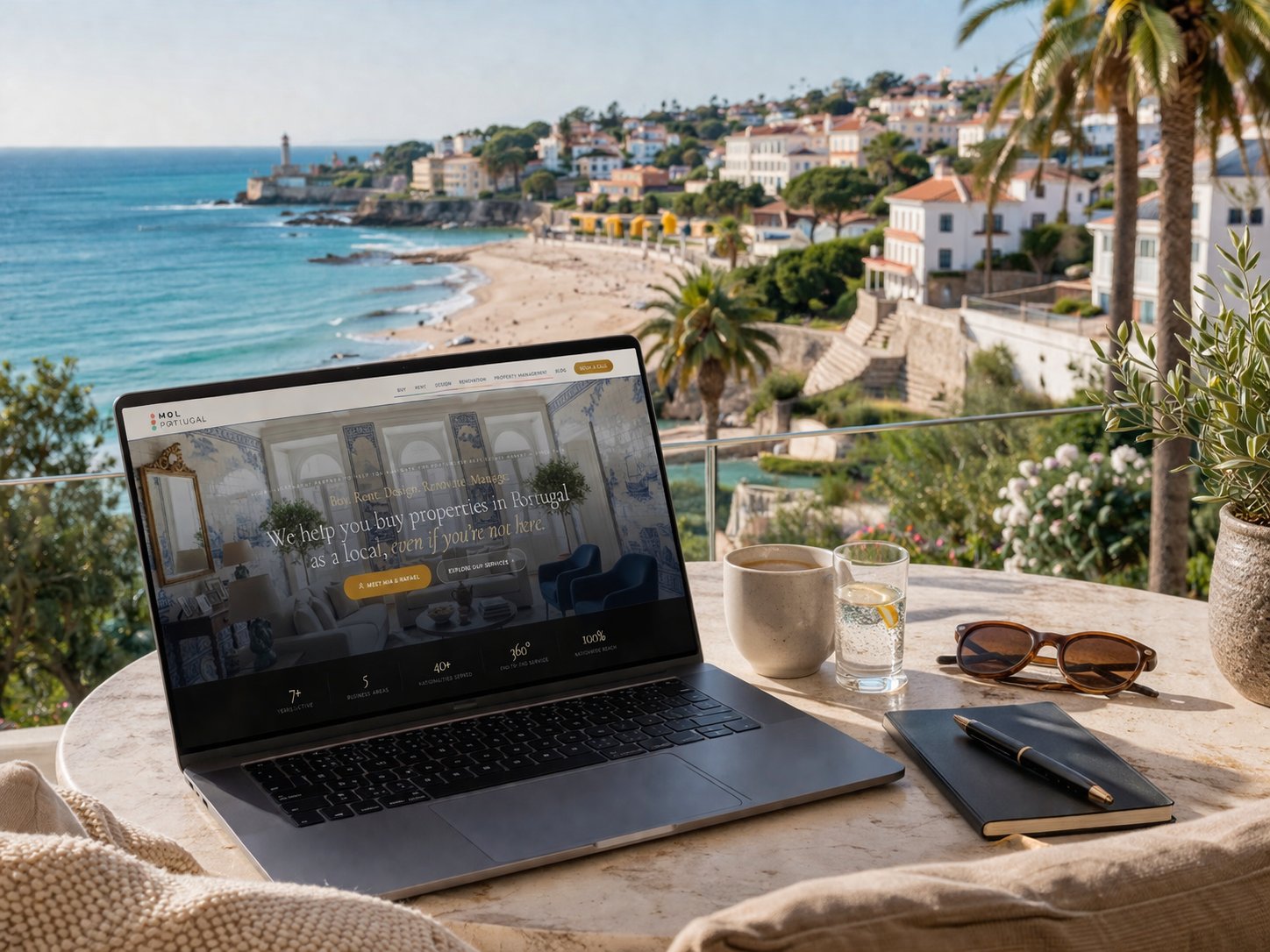
The practical implication: shortlist remotely, but verify on the ground — either by visiting yourself or by having someone you trust visit on your behalf. What photographs can’t show is what often decides whether a property works.
5. Make an offer
Once the right property is found, the offer typically goes through the seller or the seller’s agent. Negotiation culture in Portugal is more relationship-driven than transactional compared with many Anglo-Saxon markets, and pace can be slower. A confident, well-documented offer from a prepared buyer (NIF in hand, financing clarified, clear timeline) carries disproportionate weight. Aggressive opening bids often backfire. Reasonable offers with clean terms win properties that higher, messier offers lose.
6. Legal due diligence
Before you commit a deposit, your lawyer verifies that the property is what it appears to be on paper: current ownership, absence of debts or liens, licensing status, legal registration, accurate property boundaries, condominium standing, and — crucially — whether what physically exists on site matches the official documentation. Discrepancies between registered and built areas are surprisingly common in older Portuguese buildings and can block a sale or a future resale. This is not a stage to economise on.
7. CPCV (the promissory contract)
The CPCV (Contrato de Promessa de Compra e Venda) is the promissory purchase contract commonly signed before the final deed. At this stage the buyer usually pays a deposit of around 10% of the purchase price, and both parties commit legally to completing the sale under the agreed terms. If the seller walks away afterwards they typically owe the buyer double the deposit; if the buyer walks away they typically forfeit it. The CPCV is not a formality — it is the contract that actually locks the deal, and it should be reviewed carefully by your lawyer before signing.
8. Final deed (Escritura)
The final deed is signed before a notary or authorised entity. Ownership transfers, the remaining balance is paid, and the property is registered into the buyer’s name. With competent legal representation and clear documentation, this stage is mostly procedural. It is also the moment the property is, legally and in every sense, yours.
The real costs of buying
When budgeting to buy property in Portugal, budget for more than the purchase price. The additional costs are predictable but not negligible, and underestimating them is one of the most common mistakes we see. At a high level, expect to add somewhere between 6% and 10% of the purchase price on top for transaction costs, depending on the value of the property and whether you are financing. The main items:
- IMT (property transfer tax) — a progressive tax that varies by property type, value, and intended use. For permanent residence it is often zero or low up to a threshold; for second homes and higher-value properties it is meaningfully higher.
- Stamp Duty (IS) — typically 0.8% of the purchase price.
- Legal fees — vary by lawyer and scope, usually 1–2% of purchase price.
- Notary and registration fees — relatively small but required.
- Mortgage setup costs — if financing: valuation, arrangement fee, additional stamp duty on the loan itself.
We keep a live internal spreadsheet of current costs and always provide clients a tailored estimate before they make an offer. The numbers move over time, and the right framing is not a blog post paragraph but a personalised calculation for your specific scenario.
Mortgages for foreigners
Yes, many non-residents can obtain a Portuguese mortgage, but the terms are meaningfully different from those offered to residents. Non-residents typically need a larger deposit — often 30% to 40% of the purchase price, versus 10–20% for residents — and rates, maximum loan-to-value, and approval criteria vary by lender, nationality, income profile, age, and existing debts. Americans in particular encounter more friction than Europeans due to FATCA-related compliance overhead at many Portuguese banks. It is workable, but it requires going to the right banks, not the obvious ones.
If financing is part of your plan, clarify it early. A pre-agreement in principle before you start viewing properties dramatically strengthens your offers and removes the risk of finding the right property and then discovering the numbers don’t work.
Buying remotely
Yes, you can buy property in Portugal entirely remotely, and many of our clients do. The process uses video viewings (or in-person visits by your buyer’s agent on your behalf), a lawyer acting under a Power of Attorney to sign the CPCV and final deed on your behalf, digital document handling for due diligence, and remote banking setup where possible. Well-run, this works smoothly end-to-end — we have clients who bought properties of meaningful value without ever setting foot in Portugal until moving-in day.
What it requires is trust in your local representation and a process that does not cut corners on verification. A remote buyer is further from the ground, which means the on-the-ground eyes — the buyer’s agent, the lawyer, the structural surveyor where needed — have to be genuinely good. This is the one scenario where working with an independent buyer’s agent, rather than relying on seller-side intermediaries, moves from “useful” to “essential”.
Can you Airbnb any property?
No. This is the single most important misconception, and the one that blindsides the most buyers. Short-term rentals in Portugal require an Alojamento Local (AL) licence, and whether you can obtain one depends on the municipality, the building, the apartment, and the moment you apply. Large parts of central Lisbon and Porto have moratoriums or containment zones that prevent new AL licences in residential buildings. The Algarve and coastal areas are generally more permissive but still have specific rules. An AL licence attached to the property is often more valuable than the apartment itself — and buying a property expecting to Airbnb it without first confirming AL eligibility is a mistake that can easily cost a year of projected income.
If short-term rental income is part of your investment case, check AL status before you sign anything. This is something your buyer’s agent and lawyer should verify as a priority during due diligence, not as an afterthought.
Common mistakes foreign buyers make
Five patterns, all avoidable:
- Using home-country assumptions. The process is not the same as in the US or UK. Timelines are different, documentation is different, taxation is different, and negotiation culture is different. Don’t assume.
- Choosing by photographs. The prettiest apartment online is often not the best buy. Photographs flatten context. Street noise, building condition, neighbours, orientation and micro-location all disappear in a wide-angle shot.
- Underestimating legal due diligence. The cheapest lawyer is not the one you want. Cutting corners on verification is how people end up owning properties with undisclosed debts, unregistered alterations, or licensing issues that block resale.
- Assuming Airbnb is automatic. It isn’t. Verify AL eligibility before you commit.
- Trusting that listings are current. Many Portuguese property listings online are weeks or months out of date, and some are marketed by agents no longer actively working the property. A current local view is irreplaceable.
For a deeper look at the full pattern — ten specific mistakes we see most often, and the smaller earlier decisions that lead to each one — see our dedicated guide to the common mistakes foreign buyers make in Portugal.
Best places to buy property in Portugal
The right answer depends on your goal more than on any universal ranking. That said, the broad strokes:


Lisbon offers lifestyle, capital-city depth, and premium demand. Prices are high by Portuguese standards, but selectively still strong value compared with London, Paris, or major US coastal cities. Porto has stronger character and better value per square metre, with a rapidly maturing professional scene. Cascais is premium coastal living for those who want the sea and the capital in the same life. The Algarve serves holiday lifestyles and leisure buyers, with very different micro-markets between the Golden Triangle, the western Algarve, and the quieter east. Aveiro, Coimbra, and Setúbal offer alternative value plays for buyers whose goals reward moving outside the obvious metros.
There is no “best” place. There is only the place that best fits what you are trying to do — which is why step one of this whole process is defining your goal, not browsing listings. If you’re actively weighing Lisbon against Porto specifically, our honest comparison of Lisbon vs Porto for property buyers goes into the trade-offs in detail.
Do you need a buyer’s agent?
Short answer: if you are buying remotely, at higher value, or for a purpose where getting it wrong is expensive — yes. In Portugal, the vast majority of estate agents represent the seller, not the buyer. Their incentive is to close the transaction, not to make sure it’s the right transaction for you. An independent buyer’s agent represents you exclusively: market access, shortlist filtering, in-person visits on your behalf, negotiation, coordination with lawyers and other professionals, and — perhaps most importantly — the willingness to tell you when a property is wrong for your goals, even if they lose a commission by doing so.
The value of a buyer’s agent isn’t in finding properties you could find yourself. It’s in helping you avoid the ones that look good until they don’t.
For a deeper look at what buyer’s agents actually do in Portugal, who benefits most from representation, and — honestly — who doesn’t need one, our guide to why foreign buyers use a buyer’s agent in Portugal covers it directly.
Final thoughts
Buying property in Portugal as a foreigner is entirely achievable, often remotely, and — with the right preparation — one of the most rewarding property purchases you can make in Europe right now. The market rewards informed buyers and punishes assumptions. Clarity on your goal, realistic expectations, clean legal representation, and an honest local perspective on the ground matter far more than moving fast on the first property that catches your eye.
If you’re thinking about buying in Portugal in 2026 and want a sensible, honest conversation about what your specific plan could look like — we’d be happy to have it.